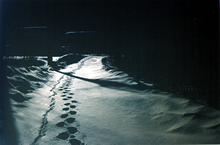
The Tibetan term bardo, the "intermediate state" [or the
in-between state], is not just a reference to the afterlife. It
also refers more generally to moments when gaps appear,
inter-ruptions to the continuity that we otherwise project onto
our lives. The interruptions in our normal sense of certainty
are what is being referred to by the term bardo. To be precise,
bardo refers to that state in which we have lost our old reality
in-between state], is not just a reference to the afterlife. It
also refers more generally to moments when gaps appear,
inter-ruptions to the continuity that we otherwise project onto
our lives. The interruptions in our normal sense of certainty
are what is being referred to by the term bardo. To be precise,
bardo refers to that state in which we have lost our old reality
and it is no longer available to us. [there is no going back].
There is a total rupture in our who-I-am-ness.
There is a total rupture in our who-I-am-ness.
We have been holding onto the idea of an inherent continuity
in our lives, creating a false sense of comfort for ourselves on
artificial ground.
in our lives, creating a false sense of comfort for ourselves on
artificial ground.
Anyone who has experienced this kind of loss knows what it
means to be disrupted... In these moments we lose our grip on
the old reality and yet have no sense what a new one might be
like. There is no ground, no certainty, and no reference point -
there is, in a sense, no rest.
means to be disrupted... In these moments we lose our grip on
the old reality and yet have no sense what a new one might be
like. There is no ground, no certainty, and no reference point -
there is, in a sense, no rest.
There is rupture in our reality...
A direct experience of disruption felt a the core of our being,
and there is no longer any use manufacturing artificial security.
and there is no longer any use manufacturing artificial security.
The bardo teachings are really about recognizing the value of
giving up the game, which we play without even knowing it.
We hold pictures/images of our ideal self in an ideal world. We
imagine that if we could only manipulate our circumstances or
other people enough, then that ideal self could be achieved, and
in the meantime we pretend to have it together... and pursue
reality as we think it should be...
giving up the game, which we play without even knowing it.
We hold pictures/images of our ideal self in an ideal world. We
imagine that if we could only manipulate our circumstances or
other people enough, then that ideal self could be achieved, and
in the meantime we pretend to have it together... and pursue
reality as we think it should be...
When we suffer disruption. we find we just can't play the game
anymore. Holding it all together is not an option.
anymore. Holding it all together is not an option.
Death and loss are great teachers, if we can open to the
experience of profound disruption.
experience of profound disruption.
Without some way of managing this experience, this unsettling
discontinuity, punctuated by occasional disruptions to the very
idea of our being, we never know if we are going to show up....
discontinuity, punctuated by occasional disruptions to the very
idea of our being, we never know if we are going to show up....
We contract with our wounded sense of self, and are dissociated
from our true nature, and make frantic efforts to create something
more ideal, more secure, more definite.
from our true nature, and make frantic efforts to create something
more ideal, more secure, more definite.
In a raw broken-open state, this place where we let go of all
games, there is actually a great sense of relief available to us,
a knowledge that we don't have to do it anymore - to *be* that;
and find way to disrupt our own habit of clinging to our
continuity story.
games, there is actually a great sense of relief available to us,
a knowledge that we don't have to do it anymore - to *be* that;
and find way to disrupt our own habit of clinging to our
continuity story.
Emerging from the bardo, we reenter the flow of life with a
new sense of groundlessness: it is clear that "later" is not always
a luxury that will be available to us... The perspective gained
in the bardo cuts through petty concerns. It cuts through delusions
so that whatever we contact, we do so with raw presence, without
the denial of impermanence. A new kind of openness becomes
available to us.
new sense of groundlessness: it is clear that "later" is not always
a luxury that will be available to us... The perspective gained
in the bardo cuts through petty concerns. It cuts through delusions
so that whatever we contact, we do so with raw presence, without
the denial of impermanence. A new kind of openness becomes
available to us.
The rupture of the bardo inevitably leads to whatever is next and
appreciating the [losses] in our lives, and the bardo for what it is -
the pause - the end that clarifies what exactly we will now be
beginning...
appreciating the [losses] in our lives, and the bardo for what it is -
the pause - the end that clarifies what exactly we will now be
beginning...
Impermanence is not just an illuminator of loss. It is the illuminator
of newness, the ever-unfolding moment and its creativity....
of newness, the ever-unfolding moment and its creativity....
Pema Khandro Rinpoche
excerpts from
"Letting Go In the Bardo"
"Letting Go In the Bardo"
from Lion's Roar
[brackets mine]
~
Photo - Mystic Meandering